A New Era of Food Festivals has Arrived
What an influencer’s curated food festival tells us about the future of restaurants | Ok, Boomer #15
A Food Festival That Was All The Rave
The most Gen Z–coded food festival just returned for its third year. It’s bigger than ever and it’s continuing to grow each time—offering a clear blueprint for what younger consumers actually want.
For many years, food festivals have followed a familiar format—chef-driven, multi-day events with tastings, demos, culinary products and legacy media as sponsors.
Now, in the 2020s, we’re seeing a new kind of festival model emerge. New York–based food influencer Jack Goldburg (@jacksdiningroom) brought together 30+ top restaurants in major cities—first New York, and now Los Angeles—for a food event that looks very different from the traditional model.
Yes Chef Food Fest is a two-day event built around constant high energy and intentionally over-the-top experiences. Despite its name, the festival doesn’t lean on celebrity chefs or traditional programming; the lineup spans everything from cult-favorite restaurants to brands like Raising Cane’s. High and low sit side by side, reflecting how younger audiences actually engage with food—less reverence, more experience.
For decades, media companies like Food & Wine helped turn small regional gatherings into destination events. What started as local tastings evolved into multi-day experiences designed to drive tourism, spotlight chefs, and attract national attention. By the 2000s, this model had scaled with celebrity chefs, cooking demos, wine seminars, and large-format tastings.
That model hasn’t disappeared, but it’s worth paying attention to the curation of these newer models and how they are breaking the rules. The mix—high-low, fast food to fine dining—is intentional. It reflects how younger audiences actually eat: fluidly driven more by experience than category.
A Raising Cane’s chicken finger eating contest (yes, really!)
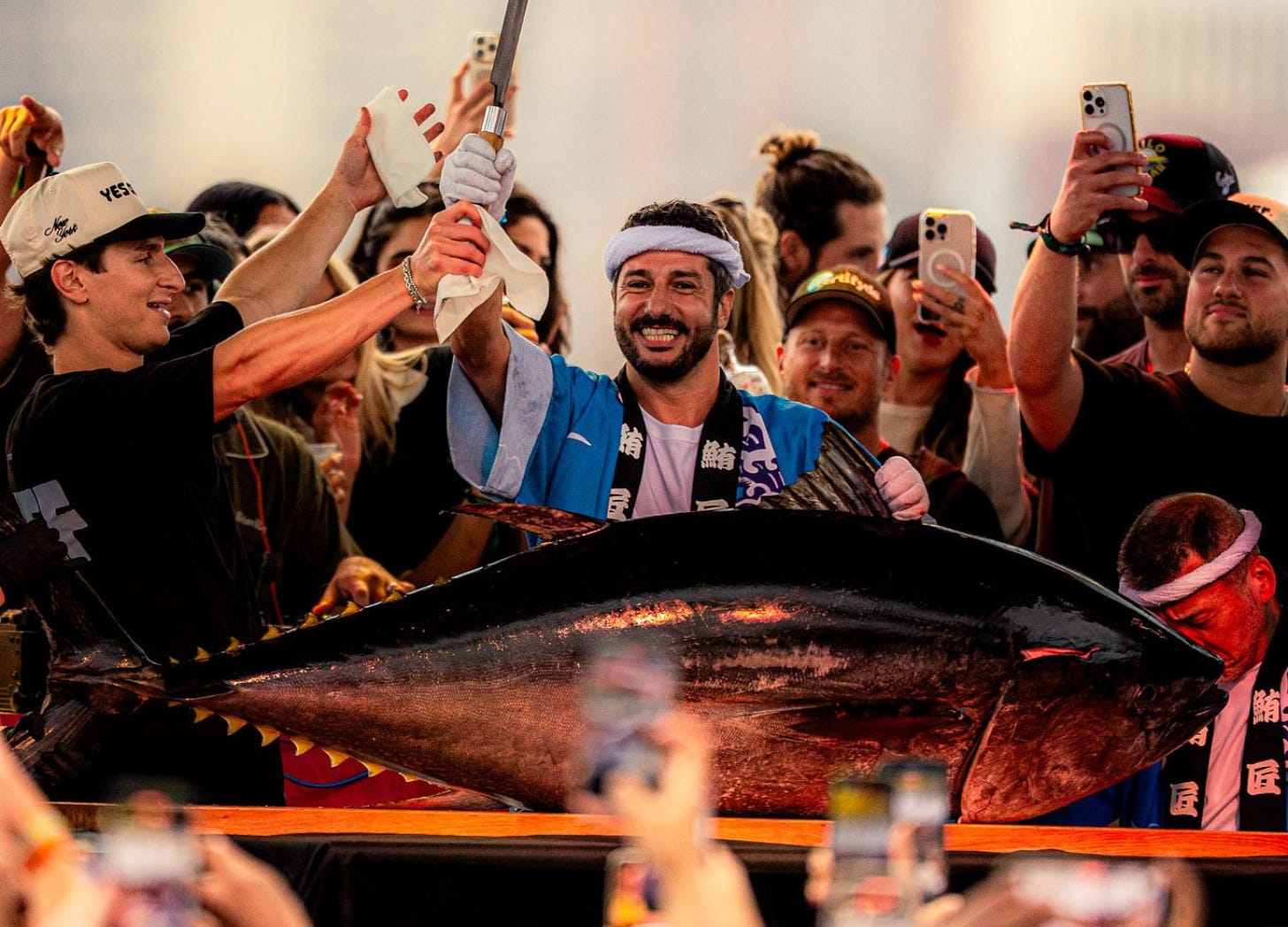
A live tuna cutting… staged like a DJ set.
A full 100 lb pig roast carved on-site, accompanied by Hawaiian dancers.
The VIP tier pushed things even further: an 18-seat Michelin-star “micro omakase” featuring wagyu sliders and premium cuts, a hand-carved prime rib station, Italian truffle tastings, and a lineup of unapologetically luxury-coded offerings.
Indulgence Is The Baseline
The biggest unlock here is that indulgence isn’t a perk anymore—it’s expected.
General admission tickets started at around $45 and it didn’t hold back. Guests weren’t just sampling—they were fully participating. Caviar bites (and bumps), cannolis, unlimited Cane’s chicken tenders, black truffle kielbasa, honey mustard pickle chips, chocolate-covered dates, fresh-cut tuna sashimi, oysters shucked on the spot and so much more. This wasn’t about portioning or restraint—it was about perceived value. If someone is paying for access, the experience has to feel generous, not controlled.
That extended to the smallest details. Buckets of free bottled water on ice were everywhere—something that’s oddly rare at most festivals, where even basic necessities are monetized. It’s a small detail, but it signals something bigger: when the experience is designed to feel abundant, people notice.
“Healthy-Ish” Still Plays By Internet Rules
Even the “better-for-you” brands showed up with the same cultural energy as everything else.
A pickle sampling bar centered around a viral pickle fountain. An LA-style fruit stand served hand-cut fruit with Tajín and citrus. Premium nuts and dried fruit were presented more like lifestyle products than traditional health food.
Larger brands also showed up in ways that aligned with this shift. Pepsi introduced a prebiotic cola while FAGE leaned into clean-label dairy.
The throughline is relevance. That these offerings showing up alongside caviar, truffles, and fried chicken fingers reflects what consumers are engaging with culturally - and online.
The Real Shift: Experience As The Product
This is where the generational difference becomes most apparent.
Younger audiences aren’t just showing up for food—they’re seeking experiences that feel curated, immersive, and worth documenting.
Even the merchandise reflected this mindset: high-quality materials, locally sourced, and designed to be worn beyond the event itself. It functioned as an extension of the experience, rather than a traditional souvenir.
Importantly, the festival wasn’t structured around discovery in the traditional sense. It brought together restaurants that audiences were already familiar with—from TikTok, Instagram, and group chats—and provided a physical space for those existing communities to engage in new ways. The demand was already there; the event simply organized and amplified it through high-energy entertainment—live games and competitions on stage, DJs, lighting, and champagne-fueled moments.
At the same time, indulgence and wellness are no longer seen as opposites. Consumers move fluidly between both. The same audience that seeks out caviar is equally interested in prebiotic soda.
Pickles, caviar, chicken tenders, bone marrow, prebiotic soda—none of these choices are incidental. Anyone who has been reading this column knows these products are social media - and Gen Z darlings. They reflect what is already circulating culturally. In this environment, alignment matters more than being first.
This Model Is Already Spreading
Food influencer Keith Lee (@keith_lee125) is hosting his first-ever “Familee Day” this May in New Orleans—a large-scale event bringing together local restaurants and curated food experiences under a creator-led banner. It’s another expression of the same model: personality-driven, experience-first, and built around what audiences already engage with online.
Insight-OUT: Creating value today isn’t about what you serve—it’s about how it’s experienced. The brands that win are the ones designing moments that feel abundant, intentional, and worth showing up for. It’s not about reverence - it’s about engagement.


